Blog
Home / Blog

Home / Blog
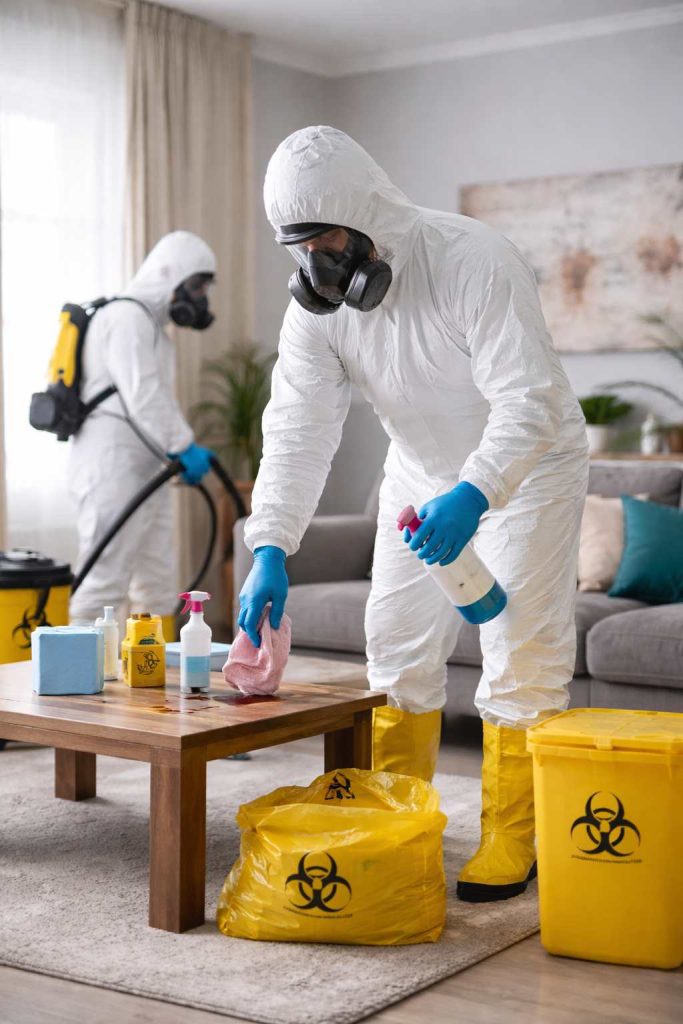
When a traumatic incident occurs — whether an unattended death, a violent crime, a suicide, or a serious accident — the aftermath leaves behind far more than emotional distress. Blood, bodily fluids, tissue matter and other biological hazards pose serious health risks that standard cleaning companies are neither trained nor equipped to handle.
This guide explains exactly what trauma cleaning involves, who needs it, and when Scottish law and health regulations make using a certified specialist not just advisable — but necessary. If you need immediate help, our biohazard and trauma cleaning team in Glasgow is available 24/7.
Trauma cleaning — also referred to as trauma scene cleanup, biohazard and trauma cleaning, or forensic cleaning — is the specialist process of decontaminating, sanitising and restoring a space after a traumatic event has left behind biological hazards.
Unlike regular or deep cleaning, specialist trauma cleaning involves the safe removal and disposal of:
These materials carry serious infection risks — including hepatitis B, hepatitis C and HIV — that require hospital-grade disinfectants, full personal protective equipment (PPE), and trained technicians to handle safely. Our infection control and public health cleaning service uses the same hospital-grade standards on every job.
When a person passes away and is not discovered for a period of time, decomposition begins rapidly. The resulting biological contamination can penetrate floors, walls and soft furnishings. This is one of the most complex trauma cleaning scenarios and requires immediate professional intervention. Learn more about how we approach biohazard and trauma cleaning in these situations.
Once Police Scotland have completed their investigation and released a property, the responsibility for cleaning falls entirely on the property owner, landlord or next of kin. Emergency services do not clean crime scenes. A certified trauma cleaning company must be engaged immediately. We work closely with Police Scotland and understand chain-of-custody protocols — read more about our crime scene and biohazard cleaning process.
These scenes require a combination of thorough biohazard decontamination and compassionate handling. Our trauma cleaning specialists are trained in both the technical and human aspects of this work. We have links with victim support organisations and mental health professionals across Glasgow — an approach reflected in our social and mental health related cleaning services.
Road traffic incidents brought indoors, serious falls, or medical emergencies resulting in significant blood loss all fall within the scope of specialist trauma cleaning. Standard cleaners lack both the training and legal authorisation to dispose of the hazardous biological waste involved.
Properties used for drug activity present multiple biohazard risks — discarded needles, blood contamination and chemical residue. Our team carries out safe needle sweeps and full decontamination in line with Health Protection Scotland guidelines. This forms part of our broader social and mental health related cleaning offering.
In Scotland, several overlapping legal frameworks apply to the handling of biohazardous waste following a traumatic incident.
COSHH regulations require that anyone handling hazardous biological substances — including blood and bodily fluids — must be properly trained and equipped to do so. Attempting to clean a trauma scene yourself, or engaging an unqualified cleaner, places you in direct breach of these regulations.
Biological waste from trauma scenes is classified as hazardous waste under Scottish law. Its disposal must be carried out by licensed contractors with the appropriate waste carrier licences and documentation. Improper disposal is a criminal offence.
Health Protection Scotland sets clear standards for the decontamination of environments contaminated with bloodborne pathogens. Certified trauma cleaning companies operate in accordance with these guidelines, providing full documentation, clearance certificates and post-cleanup verification testing.
If you are a landlord or property factor and a traumatic incident has occurred in one of your properties, you have a legal duty of care to ensure the property is safely decontaminated before it is re-occupied. Failure to do so could expose you to significant legal and financial liability. Contact our team to arrange an urgent assessment.
At Dublcheck Bio Cleaning Glasgow, our certified trauma cleaning process follows a structured, regulation-compliant approach:
Every job is carried out discreetly, with full respect for the privacy and dignity of those involved. Our documentation package also supports insurance claims and regulatory compliance requirements.
Not all cleaning companies are equipped — or legally permitted — to handle trauma scenes. When choosing a biohazard and trauma cleaning specialist in Glasgow or across Scotland, ensure they hold:
Dublcheck Bio Cleaning Glasgow holds all of the above. Our technicians come from backgrounds in healthcare, emergency services and environmental health — giving you technical expertise and human understanding in equal measure. We are also fully equipped for environmental and structural restoration where incidents have caused wider property damage.
Available 24/7 — we respond within 2 hours across Glasgow and surrounding areas.
📞 Call us now: 0141 370 0504
Or get a free, no-obligation quote online.
Certified technicians. Discreet service. Fully insured.
Our rapid response teams are available 24 hours a day, 7 days a week, and aim to be on site within two hours of your call anywhere in Glasgow and the surrounding areas. Biological hazards deteriorate rapidly, so we treat every call as an emergency. Call us now or submit an urgent request online.
No. Under COSHH regulations and the Hazardous Waste (Scotland) Regulations 2005, handling and disposing of biological hazardous waste without proper training, certification and licensing is illegal. It also places you and others at serious risk from bloodborne pathogens. Our biohazard and trauma cleaning team is trained and certified to handle these situations safely.
In many cases, yes. Home and commercial property insurance policies often cover trauma cleaning and biohazard remediation, particularly following criminal incidents or unattended deaths. We provide full documentation — including waste manifests and clearance certificates — to support your insurance claim.
Yes. While we are based in Govan, Glasgow, we serve clients throughout Greater Glasgow and across Scotland. Contact us to confirm coverage for your location.
This depends on the scale and nature of the incident. A contained scene may be completed within a few hours; more severe contamination involving structural penetration can take one to two days. We provide a clear timeline during our initial assessment.
Absolutely. Our vehicles are unmarked and our team works with complete discretion. We understand the sensitivity of these situations for families, landlords and businesses, and treat every job with the highest level of professionalism and confidentiality.